
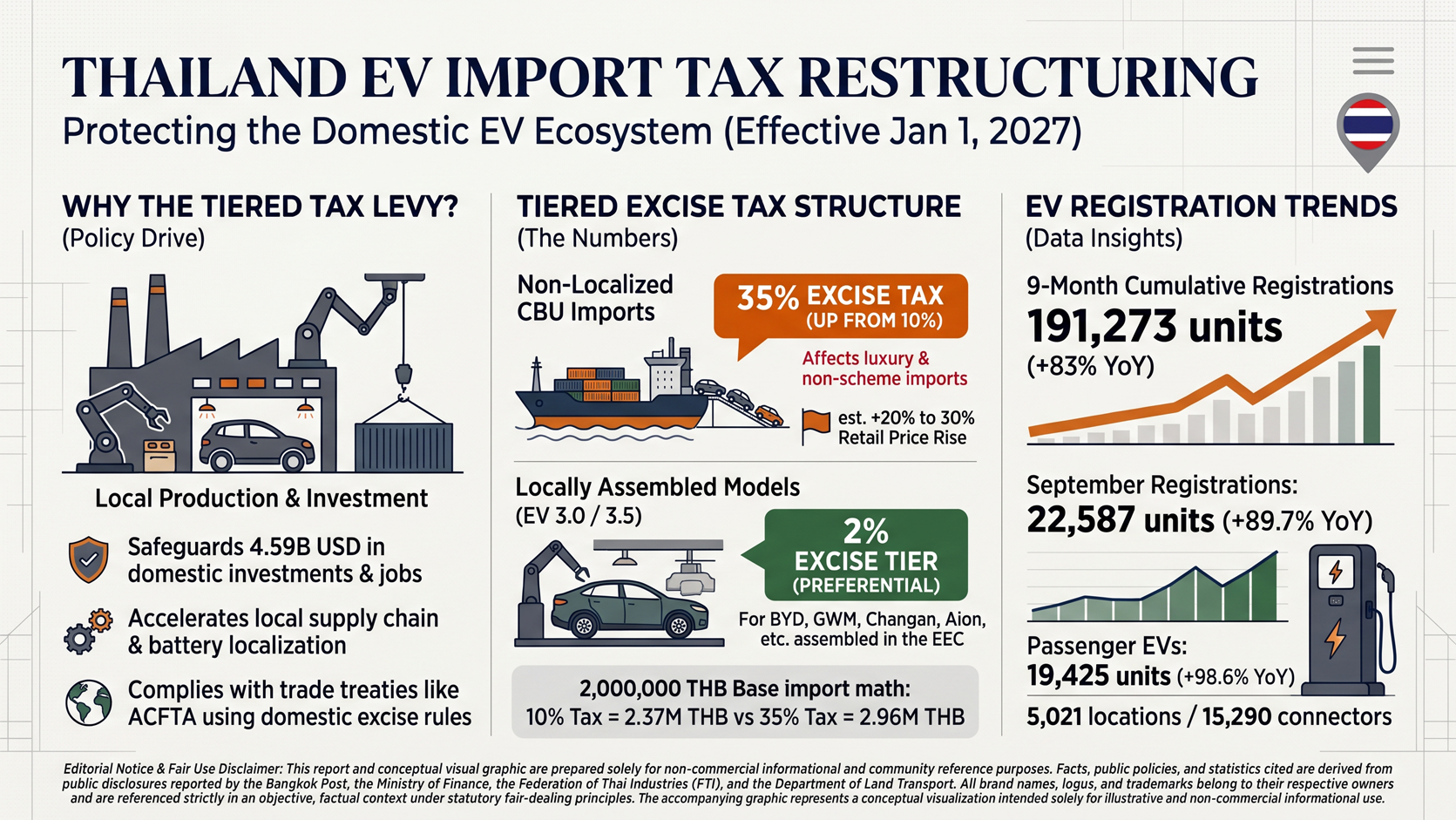

Thailand EV Excise Tax on CBU Imports Rises From 10% to 35% in 2027
Thailand’s Cabinet has approved an increase in the excise tax on fully imported electric vehicles (EVs) to 35%, up from 10%, effective from January 1st, 2027, according to official statements reported by the Bangkok Post.
The policy restructuring, announced by Finance Minister Ekniti Nitithanprapas, aims to protect domestic manufacturing investments and encourage overseas automakers to localize assembly operations within Thailand.
Key Policy Drivers
(1) Encouraging Local Production: The higher levy applies to completely built-up (CBU) passenger EVs imported without local manufacturing or assembly agreements. Automakers establishing production facilities within Thailand, particularly in the Eastern Economic Corridor (EEC) will maintain access to lower domestic excise tax tiers.
(2) Capital Protection: This latest revision aims to safeguard the billions of Thai Baht already invested by automakers that have constructed local assembly plants and battery facilities.
(3) Trade Framework Compliance: By adjusting internal excise consumption taxes rather than custom tariffs, the policy operates within existing trade agreements, including the ASEAN Free Trade Area and ASEAN-China Free Trade Agreement.
EV Market Growth
The announcement comes alongside substantial expansion in Thailand’s zero-emission vehicle sector:
(a) Registration Growth: Electric Vehicles and Electric Motorcycle registrations reached 22,587 units in September, up 89.7% year-on-year, based on Department of Land Transport figures cited by the Federation of Thai Industries (FTI).
(b) Passenger Adoption: Passenger EVs accounted for 19,425 registrations during the month, up 98.6% year-on-year.
(c) Year-to-Date Volume: Total registrations reached 191,273 units across the first nine months of the year, with full-year figures projected to reach between 200,000 and 220,000 units.
(d) Public Infrastructure: Nationwide charging infrastructure expanded to 15,290 connectors across 5,021 locations by the end of September, 2026.
Market & Consumer Implications
The planned tax increase will bifurcate the domestic vehicle market beginning in 2027:
(1) Imported Models: High-end and niche electric models imported without domestic production arrangements potentially face retail price increases of 20% to 30%.
(2) Locally Assembled Models: Vehicles built by manufacturers with domestic assembly operations (such as BYD, GAC Aion, Changan, GWM, and Toyota) remain except from the import penalty, preserving competitive retail pricing.
(3) Purchasing Considerations: Thai buyers and expatriates planning to acquire luxury or non-localized CBU imports may benefit from purchasing before the January 1st, 2027 deadline. For localized mainstream brands, ongoing production volume and manufacturer incentives are expected to maintain stable pricing.
*Disclaimer: This report and accompanying graphic are prepared strictly for informational, educational, and community reference purposes. Factual disclosures, policy analysis, and statistical data cited herein are attributed to public reporting by the Bangkok Post, the Ministry of Finance, the Federation of Thai Industries (FTI), and the Department of Land Transport. All company names, brand marks, and registered trademarks remain the exclusive property of their respective holders and are referenced solely for objective context under fair dealing principles. The accompanying graphic represents a conceptual visualization intended solely for illustrative and non-commercial informational use.
Last Updated November 03, 2026

